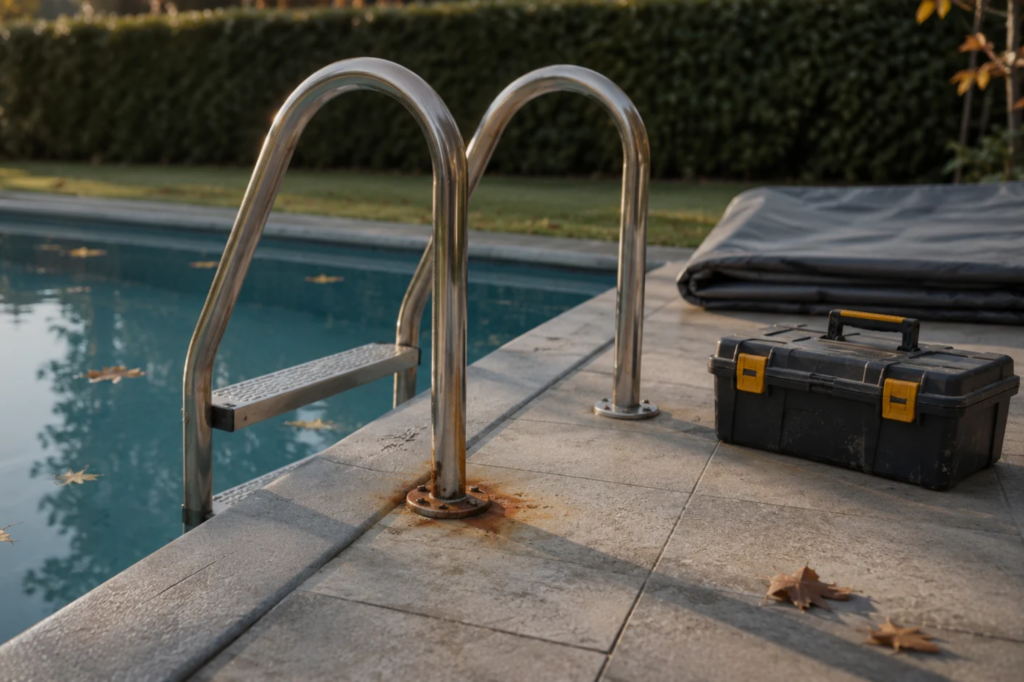
A swimming pool costing nearly €74,000
In 2016, a client has a swimming pool installed. Upon completion, he tacitly accepts the works. Shortly afterwards, he discovers scratches, sharp edges and rust stains. He withholds payment of the final invoice of over €8,500 until the contractor remedies the defects. When the technical equipment also fails, the swimming pool becomes unusable for more than two weeks. The contractor, in turn, suspends the remedial works as long as the invoice remains unpaid. The dispute over that invoice resulted in nearly ten years of litigation and two court-appointed expert investigations.
When can you suspend payment or remedial works?
Both parties invoke the defence of non-performance. This defence may entitle a party to temporarily suspend the performance of its own obligation for as long as the other party fails to fulfil a related obligation that is due for performance. The right to suspend performance must be exercised in good faith.
The Court of Cassation confirmed that payment of a final invoice and the repair of defects causing loss of use can be sufficiently closely linked. In this case, the Court of Appeal held that the client had wrongfully withheld payment of the final invoice and that the contractor was entitled to suspend the remedial works. The project owner was therefore not awarded compensation for the loss of use caused by the delayed repairs. Whether the contractor was responsible for the defect was irrelevant in this respect. The Court of Cassation held that the decision was justified in law. Whether the right to suspend performance is exercised in good faith is a matter for the court to assess in the light of the specific circumstances, such as the nature of the defects and the amount withheld.
What you can do when a final invoice is disputed
As a client, you should test the installation upon completion and record any visible defects in the acceptance report. Accepting the works without reservation may affect your rights in relation to visible defects. Report any defects promptly and in writing, document them and give the contractor an opportunity to investigate them. Consider what amount would be proportionate to the works in dispute.
As a contractor, you should respond in writing to the reported defects. Specify which issues you acknowledge or dispute, which remedial works you can carry out and which you consider yourself entitled to suspend. A proposal regarding payment of the undisputed amount and the timing of a site visit may help move discussions forward.
Mediation at Andersen: an alternative to ten years of litigation. From “Who is right?” to “How can we resolve this?”
When both the client and the contractor are waiting for the other to act, a neutral mediator can help them reach practical agreements. These might include immediate payment of the undisputed amount, a joint assessment of the remaining defects by an expert, and a schedule for remedial works with clear arrangements for inspecting the works and paying the outstanding balance.
This case illustrates the cost of litigation. The dispute dragged on for nearly ten years, passing through the court of first instance, the Court of Appeal and the Court of Cassation, and involving two court-appointed expert investigations. Throughout that period, both parties remained uncertain about the outcome, with all the stress that entails. Mediation would have offered them an alternative.
Speed. Mediation generally takes place over a few sessions, spanning weeks or months rather than years. The parties set their own pace and agenda. Once an agreement is reached, remedial works can begin and the swimming pool can be brought back into use.
Costs. The parties share the mediator’s fees. They avoid the costs of litigation before multiple levels of jurisdiction, including lawyers’ fees, court-appointed expert investigations and procedural indemnities, which, in a dispute over an invoice of just over €8,500, can quickly exceed the amount in dispute itself.
Confidentiality. Anything said or submitted during mediation is confidential and cannot subsequently be used in court proceedings. This often creates greater scope for open dialogue than litigation. A court judgment, by contrast, is public and is often published, as was the judgment in this case.
A forward-looking approach. A court primarily looks to the past: who breached which obligation, and what compensation is due? Mediation, by contrast, focuses on the future. The parties work together to find a practical solution that takes into account their shared and compatible interests. In a construction dispute, this might involve a combination of remedial works, payment arrangements, maintenance, warranties or continued cooperation.
Reputation protection. For a contractor, reputation among clients and within the industry matters. For a client, maintaining a relationship with a skilled professional who still needs to carry out repairs and maintenance is important. An agreement allows both parties to bring the dispute to an end without a winner or a loser, and without making it public.
Moreover, mediation can be initiated at any stage, even when court proceedings are already underway.
The Real Estate team at Andersen in Belgium advises clients and contractors on their legal position and assists them in negotiations and mediation. Are both parties jointly seeking a neutral mediator? Ulrike Beuselinck and David Van Iseghem, partners at Andersen and accredited mediators, can fulfil this role where they are jointly appointed by the parties and Andersen is not advising or representing either party in the matter. Has your construction project reached a deadlock over an invoice or a dispute concerning remedial works? Contact Andersen to discuss which approach is best suited to your case.